Soft wash roof cleaning is a low pressure method that removes algae, moss, lichen, and black streaking by applying a diluted biocidal solution, holding it wet on the surface until the growth is killed at the root, and rinsing the roof with fresh water. The work is done by the chemistry and the contact time, not by force, which is why it is the method the Asphalt Roofing Manufacturers Association recommends for asphalt shingle and why it does not strip granules or crack tile. Ventura County Roof Cleaning soft washes tile, shingle, metal, and flat roofs across Ventura County, CA, and every job starts with a free on-site estimate.
Key Takeaways
- A soft wash is a dose, and a dose is strength multiplied by time. A crew that finishes fast on a heavily grown roof is running a stronger mix, not a better process.
- The only variable you can audit from the ground is dwell time. Ask how long the solution sits before it is rinsed. Anyone can say “eco-friendly solution”; almost nobody will answer that question.
- We rinse the roof on the day. The apply-and-leave method common in rainy states assumes weather will finish the job. Ventura County gets effectively no rain from roughly May through October, so there is no weather to finish it.
- Plant damage from a roof wash shows up days later, not on the day. The yard looking fine when the crew leaves is not evidence that it was protected.
- There is no square foot price for a roof cleaning. Pitch, stories, material, access, and how long growth has been established move the work more than area does.
Roof Cleaning Service in Ventura County: The Three Variables
Every roof cleaning company sells the same four words: safe, low pressure, eco-friendly solution. None of that is a specification. A soft wash is controlled by exactly three variables, and understanding them is the difference between comparing bids and guessing between them.
The one that matters most is the relationship between the first two. Killing biological growth requires a dose, and dose is concentration multiplied by contact time. A weaker solution held wet for twenty minutes and a much stronger solution flashed on and rinsed off in five can reach a similar kill. They are not equivalent jobs. The excess in the fast version does not disappear; it ends up in the runoff, on the flashing, and in the beds below the eaves.
| Variable | What it controls | What goes wrong when it is off | What to ask a contractor |
|---|---|---|---|
| Concentration | How quickly the solution kills algae, moss, and lichen | Too weak and the roof greys out but regrows within months. Too strong and the runoff burns landscaping, dulls painted metal, and accelerates corrosion at fasteners and flashing | What strength do you mix for my roof material |
| Dwell time | The actual work. Longer contact lets a gentler mix reach the same result | Solution that flash-dries in the sun has stopped working, and it leaves concentrated residue baking on the surface instead of rinsing away | How long will the solution be on my roof before you rinse |
| Rinse | Carries off dead biomass, spent solution, and loosened mineral film | A skipped rinse leaves the chemistry on the roof and drops the whole load into the gutters and the beds at the first rain | Do you rinse the roof, and do you re-rinse the landscaping afterwards |
For reference on the first row, the Asphalt Roofing Manufacturers Association’s guidance for algae on asphalt shingle is a 1:1 mix of chlorine bleach and water, allowed to sit briefly and then rinsed at low pressure. That puts a working roof solution in the range of roughly 2 to 3 percent sodium hypochlorite at the surface. Our metal roof cleaning guide explains why coated and painted panels sit at the low end of that range rather than the high end.
Dwell is also why a soft wash is scheduled around surface temperature rather than around the calendar. Solution that dries before it has worked is wasted, and in the hot inland valleys that constraint narrows the working window to the early morning. The mechanism is covered in our guides to roof cleaning in Woodland Hills and the best time of year to clean a roof in Ventura County.
Why We Rinse the Roof, and Why That Is a Local Question
There are two schools in the soft wash trade. One rinses the roof at the end of the visit. The other applies the solution and leaves it, sometimes marketed as a no-rinse or dry-fall treatment, on the theory that rain will carry the dead growth and the spent chemistry away over the following weeks.
In a climate with year-round rainfall that argument is at least arguable. In Ventura County it is not, and the reason is the shape of the local water year rather than the annual total. Coastal Ventura County averages roughly 15 inches of rain a year against the NOAA 1991 to 2020 normals, but that rain is not spread across the year. California’s precipitation arrives in a small number of large winter storms, with atmospheric rivers supplying roughly 30 to 50 percent of the state’s annual total according to the Scripps Institution of Oceanography’s Center for Western Weather and Water Extremes. From roughly May through October, most of the county records almost nothing.
| Application style | The stated theory | What it actually means in Ventura County | Our practice |
|---|---|---|---|
| Rinse on the day | Fresh water at low pressure removes dead biomass and spent solution before the crew leaves | The roof is finished when the crew leaves, in any month | This is what we do on every roof |
| Apply and leave, no rinse | Rain will wash the roof over the following weeks | A job done in June may wait five months for the first meaningful storm | Not used |
| Apply and leave, then rinse later | Return visit handles the rinse | Two mobilizations for one job, and the residue sits in between | Not used |
Three things follow from that. The dead mat stays on the roof, which defeats the purpose, because dead moss and lichen hold moisture against the roofing material exactly like living growth does. The residue keeps working on the surfaces you did not want treated, which on a coastal roof means painted flashing, vent collars, and fasteners already under chloride load. And when the first storm finally arrives in late autumn, it does not gently dilute five months of accumulation. It flushes the whole load into the gutters and the planting beds in one event.
What a rinse does not do is make the roof instantly uniform. Algae bleaches out during the visit, but heavy moss and lichen die on the day and release over the following weeks. That timeline, and the reason we do not scrape a dead mat off the same day, is set out in our guide to roof moss and algae removal in Ventura County.
How Your Landscaping Is Actually Protected
Every roof cleaning page in the country promises to protect your plants. Very few say what that means, and the reason is that the protection is not a product. It is dilution, applied three times.
Sodium hypochlorite is phytotoxic in concentration and it neutralizes rapidly on contact with organic matter and dilutes with water. So the entire defense is keeping the concentration at the plant low: wet the beds before anything is applied so the foliage and root zone are already saturated and cannot take up much more, keep water moving through the beds while the roof is being worked, and rinse everything again once the roof rinse is finished and the runoff has stopped.
| Stage | What happens | Why it matters |
|---|---|---|
| Before | Beds, lawn, and any sensitive specimens below the eaves are soaked with fresh water, and delicate plantings are covered | A saturated plant cannot absorb much more liquid, so anything that reaches it arrives already diluted |
| During | Water keeps running through the beds under the active roof plane while the solution dwells | Dilution has to be continuous, because the runoff is continuous |
| After | Beds are flooded again once the roof rinse is complete, and hardscape and painted surfaces below are rinsed down | This is the step that gets skipped, and it is the one that decides the outcome |
| Days 3 to 7 | Any damage that was going to occur becomes visible as leaf-margin scorch or browning | The verification window, and the reason the day of service proves nothing |
That last row is the part almost nobody publishes, and in our field experience it is the single most common source of disputes in this trade. Chemical injury to foliage does not present while the crew is on site. It appears over the following few days, after the plant has moved the chemistry through its tissue. So “the yard looked fine when they left” is not evidence of anything, and the crew that skipped the post-rinse is never the crew that is still there when it shows.
Two practical consequences for homeowners. If you have specimen plantings, mature Japanese maples, camellias, ferns, or anything newly planted directly under an eave, say so during the estimate rather than on the day. And if you are comparing bids, the pre-wet and post-rinse are labour, so a bid that is dramatically cheaper is frequently cheaper because that labour is not in it.
What Soft Wash Roof Cleaning Will Not Fix
Being straight about the boundary is part of the estimate. A soft wash is a biological treatment plus a rinse. It does not do any of the following, and we will tell you so on site rather than after payment.
- Corrosion already in the metal. Rust at fasteners, vent collars, and flashing is a material change, not a deposit. Cleaning stops it being fed; it does not reverse it. The coastal mechanism is covered in our Oxnard roof cleaning guide.
- Granule loss that has already happened. Once the mineral surface of an asphalt shingle is gone, nothing puts it back. This is the entire argument against pressure washing a roof.
- Lichen ghosting. Mature lichen bonds into the substrate and can leave a pale outline after the organism is dead, particularly on concrete tile. It is cosmetic and it fades, but it does not always clear on the first visit.
- Cracked, slipped, or broken tile. We flag it. We do not replace it.
- Leaks and structural work. We are a cleaning company, not a roofer. If a roof is leaking or failing we say so and refer it out. Our guides to roof leaks in Ventura County and cleaning versus replacement cover where that line sits.
- A roof at the end of its life. The Asphalt Roofing Manufacturers Association puts architectural asphalt shingle service life at roughly 20 to 30 years. On a roof past that, with granules in the gutters and curling across multiple slopes, a cleaning is cosmetic and we will say so.
Residential Roof Cleaning Near You: What Changes by Roof Type
We soft wash every residential roof type in Ventura County. The method does not change. Concentration, dwell, and handling do.
Tile Roof Cleaning
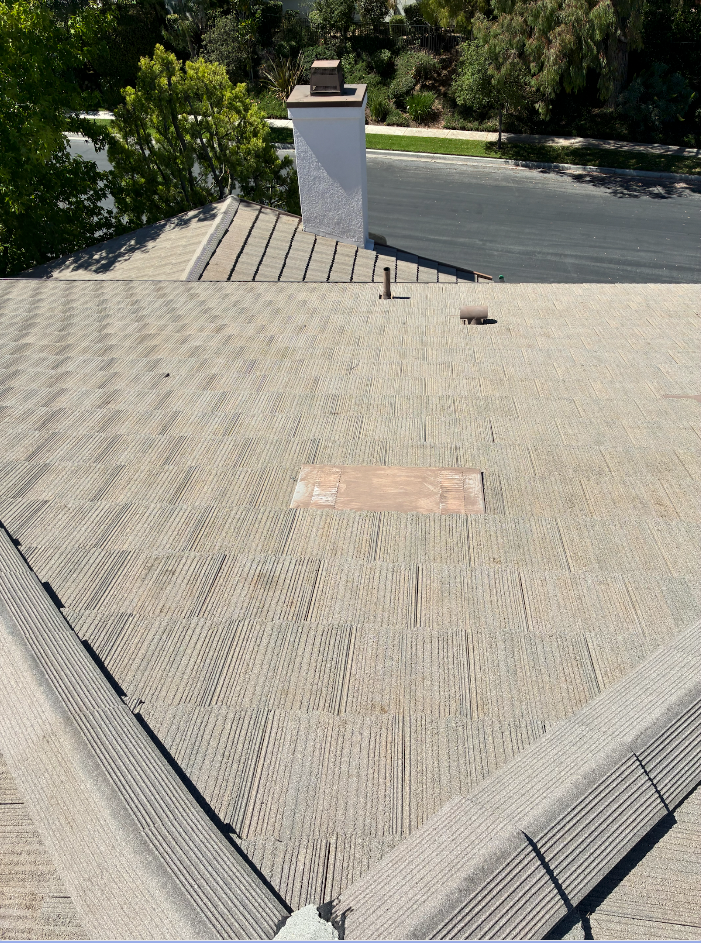
Clay and concrete tile take the gentlest pressure of any roof surface and the longest dwell, because inland lichen bonds chemically into the cement matrix rather than sitting on top of it. Full detail on our tile roof cleaning service page.
Shingle and Composition Roof Cleaning
Asphalt and composition shingle is the roof type ARMA writes its guidance for, and the granule layer is the whole reason low pressure is non-negotiable. See our asphalt shingle roof cleaning guide.
Metal and Flat Roof Cleaning
Painted, coated, and Kynar finished panels sit at the low end of the concentration range and must never be cleaned hot, because solution that bakes onto a hot panel oxidizes the finish. See our metal roof cleaning guide.
Skylights, Solar, and Roof Details
Skylights, chimneys, vents, and solar mounts are masked or worked around, and glass surfaces get a final rinse with deionized water rather than tap water, because local supply runs hard enough to dry to a visible carbonate film on anything that has to stay optically clear. Array cleaning itself is covered on our solar panel cleaning page.
Commercial Soft Wash Roof Cleaning
Offices, retail, industrial buildings, and HOA managed communities, scheduled outside operating hours where access requires it. See our HOA and property manager guide.
What Drives the Cost of a Soft Wash
There is no square foot rate for roof cleaning, and any company that quotes one over the phone has not seen the two things that move the number most. These are the factors we price on, in roughly the order they matter:
- Growth severity and how long it has been established. A first-season algae film and a decade of mature lichen are not the same job even on the same roof, because the second one is a dwell-time and second-pass problem.
- Roof material. Tile, shingle, metal, and flat each carry a different pressure ceiling and a different concentration.
- Pitch and access. Steep and high roofs need fall protection and slow the work far more than the extra area suggests.
- Number of stories. Reach and staging, not area.
- What is underneath. Dense planting under the eaves adds real pre-wet and rinse labour, and it is labour we do not cut.
- Location within the county. Coastal roofs carry a salt load that no biocide affects, so they need extra fresh water rinse volume on top of the biological treatment.
We quote every roof after a free on-site estimate, in writing, with no hidden extras. For how the factors interact, see our roof cleaning cost guide for Ventura County.
Roof Cleaning Near Me: Every Ventura County City We Serve
If you are searching for roof cleaning near me in Ventura County, Ventura County Roof Cleaning is the local specialist, and there is a crew working within a short drive of your home most days of the week. We are based in Ventura County and soft wash tile, shingle, metal, and flat roofs across the entire county and the adjacent Conejo Valley and west San Fernando Valley.
| Area | Cities we serve |
|---|---|
| Coastal | Ventura, Oxnard, Port Hueneme |
| Conejo Valley | Thousand Oaks, Westlake Village, Newbury Park, Agoura Hills |
| Inland | Camarillo, Simi Valley, Moorpark |
| Ojai and Heritage Valley | Ojai, Santa Paula, Fillmore |
| Adjacent | Calabasas, Hidden Hills, Woodland Hills |
Where you sit in that table changes the work. Coastal roofs in Oxnard and Port Hueneme carry a chloride salt load that no biocide touches, so they need fresh water rinse volume on top of the biological treatment, while roof cleaning in Simi Valley and Moorpark is a lichen and nutrient job, because wildfire ash and grove soil feed growth that dew alone keeps alive. The city of Ventura splits both ways inside its own limits: soft wash roof cleaning in Ventura, CA is a salt and corrosion job at Pierpont and a lichen and dwell-time job a mile and a half uphill in Ondulando, which is why the same treatment does not suit both.
Searching “roof cleaning near me” will return general pressure washing companies alongside actual roof cleaning specialists, and the difference matters enormously. Ask any local roof cleaning company two questions before you hire: how long the solution will dwell before it is rinsed, and what they do to the landscaping before, during, and after. Our buyer’s guide to choosing a roof cleaning company covers what else to verify before you sign anything.
Why Homeowners Choose Ventura County Roof Cleaning
- Soft wash only, on every roof. We do not own a process that pressure washes a roof slope, which means there is no version of this job where the wrong tool comes off the truck.
- Licensed and insured. An active California state contractor’s license and general liability cover. Verify any contractor’s license free at the CSLB, and note that unlicensed work above the $500 threshold is illegal in California.
- The rinse is included, always. Roof and landscaping, on the day, on every property.
- We tell you when not to buy. If the roof is too far gone for a cleaning to be worth it, that is what the estimate will say.
- Local. Every city listed above is served by crews that work this county every week, not by a franchise dispatched from out of area.
Frequently Asked Questions
Is there roof cleaning near me in Ventura County?
Yes. Ventura County Roof Cleaning serves every city in Ventura County, including Ventura, Oxnard, Camarillo, Thousand Oaks, Simi Valley, Moorpark, Newbury Park, Westlake Village, Agoura Hills, and Ojai, plus adjacent Calabasas and Woodland Hills. We are a local roof cleaning specialist rather than a general pressure washing company, which means every roof is soft washed at low pressure rather than blasted.
What is soft wash roof cleaning?
Soft wash roof cleaning is a low pressure method that removes algae, moss, black streaking, and lichen by applying a diluted biocidal solution, holding it wet on the surface long enough to kill the growth at the root, and rinsing with fresh water. It is used on tile, shingle, metal, and flat roofs, and it is the method the Asphalt Roofing Manufacturers Association recommends for asphalt shingle.
What is actually in the soft wash solution?
A diluted sodium hypochlorite solution, the same active ingredient as household bleach, plus a surfactant so it clings to a pitched surface long enough to work. ARMA’s published guidance for algae on asphalt shingle is a 1:1 mix of chlorine bleach and water, rinsed at low pressure, which puts a working roof solution around 2 to 3 percent sodium hypochlorite at the surface. Painted and coated metal is treated at the low end of that range.
Do you rinse the roof, or leave the solution on it?
We rinse, on the day, on every roof. Some companies apply the solution and leave it for the rain to carry off. That method assumes rainfall that Ventura County does not get between roughly May and October, so a summer job would sit with dead biomass and spent solution on it for months, then dump the whole load into the gutters at the first storm.
Why does a soft wash take longer than a pressure wash?
Because the solution is doing the work and it needs contact time. Killing growth requires a dose, and dose is concentration multiplied by dwell. A crew that is off a heavily grown roof in under an hour is not faster, it is running a stronger mix, and the excess ends up in the runoff, on the flashing, and in the beds below.
Will roof cleaning kill my plants?
Not when the landscaping is pre-wet, kept flooded during the wash, and rinsed again afterwards, because that keeps the concentration reaching any plant very low. Tell us during the estimate if you have specimen plantings or new planting directly under an eave. One thing worth knowing: chemical injury to foliage shows up over the following few days rather than on the day, so a yard looking fine when the crew leaves is not proof that it was protected.
How long until my roof looks clean?
Algae and black streaking bleach out during the visit. Moss and lichen die on the day but release over the following weeks as they dry and lose grip, and heavy growth sometimes needs a second visit. We do not scrape a dead mat off the same day, because doing that on a still-bonded colony takes surface material with it.
How often should a roof be soft washed in Ventura County?
Somewhere between 12 and 36 months, and where you live moves that more than anything else. Homes on the sand at Pierpont, Oxnard Shores, or Hollywood Beach run closer to 12 months because of the salt load; the coastal plain and canopied inland tracts sit around 18 to 24 months; dry, open valley lots in Woodland Hills and the eastern Conejo Valley stretch to 24 to 36. The right interval is the one that stops growth re-establishing, not a fixed calendar.
How much does soft wash roof cleaning cost?
There is no square foot rate. Cost is driven by how established the growth is, the roof material, pitch, access, number of stories, planting below the eaves, and where in the county the property sits. We quote in writing after a free on-site estimate, so the number reflects your roof rather than an average.
Can you soft wash a tile roof without cracking it?
Yes, and it is the only safe way to clean one. Clay and concrete tile take the lowest pressure of any roof surface, and the pressure that would remove bonded lichen mechanically would also strip the tile surface. It is handled as a dwell-time job instead. Details are on our tile roof cleaning page.
Complete Your Exterior Cleaning
While we are protecting your roof, many homeowners add tile roof cleaning for clay and concrete tile, gutter cleaning so the debris rinsed off the roof does not sit in the trough, solar panel cleaning to restore output, or pressure washing for driveways and hardscape. Looking for a roof cleaning service in your city? See our service areas in Ventura, Thousand Oaks, Simi Valley, and Camarillo.
Ready for a cleaner roof? Request a free roof cleaning estimate or call Ventura County Roof Cleaning at (805) 908-2005.